


Roots and genesis: self-taught formation, the father's sheet metal, Brera, the position on the margins, the deeper motivations.
The work of Angelo Marchetti did not arise from an academic path, but from an expressive need that precedes and exceeds any codified training. To reconstruct its origins is to trace back the roots of a vocation that asserts itself by contrast—against expectations and already-mapped paths—and that finds its very energy in this friction.
 The raw material: the workshop.
Angelo's first contact with form took place in the workshop of his father, a tinsmith in Milan. It was here, amid the working of sheet metal, that the adolescent produced his first engravings on metal and his first sculptural pieces. This artisanal origin, far from lecture halls and manuals, left a lasting mark: the relationship with matter, the physical engagement with making, the direct knowledge of the gesture would remain constants in his way of understanding art. Engraving on sheet metal, his first means of expression, would accompany the entire trajectory of his production, bearing witness to a faithfulness to that source.
The first recognition of this inclination came from within the family, through a paternal uncle who, sensing Angelo's artistic disposition, gave him his first paints and so opened the way to painting. But the family circle, oriented towards commercial studies and the continuity of the father's business, was unable to understand or support that direction. From this lack of recognition the first fractures were born, and with them the awareness that his own road would be travelled in solitude.
The choice of uncertainty.
As he passed into adulthood, his father's wish to settle him permanently into the family business came into conflict with his personal search. Marchetti refused an already-defined trajectory and chose uncertainty: he developed his own language as a self-taught artist, in a direct confrontation with matter and with experience, without the mediation of a school. This founding decision explains many features of his mature work, from its freedom with regard to convention to its mistrust of any ready-made formal system.
To support himself, after voluntarily distancing himself from his family of origin, he worked as an interior decorator, in a life divided between functional necessity and research, the two ever harder to reconcile. Only with the opening of his own studio, in the early 1960s in Via Giovanni Raiberti, was he able to devote himself to painting as his principal activity, making it at once the centre of his work and the place of exchange with other artists.
Brera and the position on the margins.
From the late 1950s Marchetti frequented Brera, then the heart of Milanese artistic bohemia. He came into contact with the cultural climate of the city and absorbed its stimuli, but always kept to a position on the margins: he adhered to no movement, sought no affiliations, and preserved a discreet presence and a distance that was at once temperament and deliberate choice. He observed and assimilated, without letting himself be reduced to any shared language.
The root of the search.
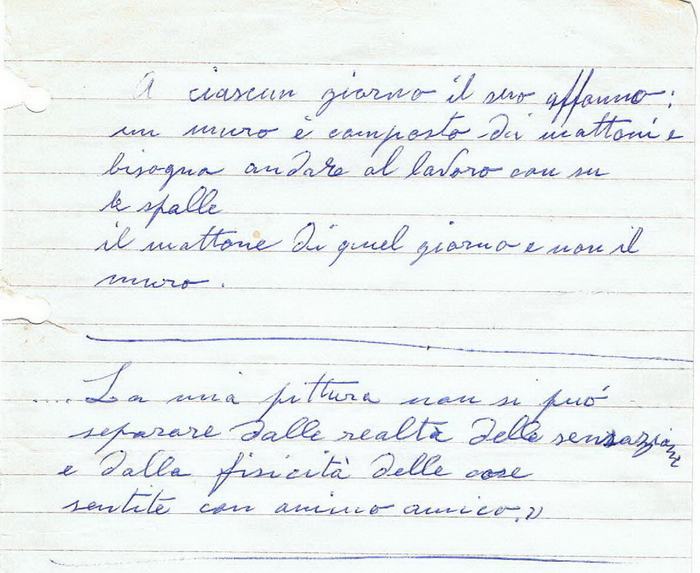
At the origins of the work, then, there is no aesthetic programme but an existential impulse. From the very beginning, creation was for Marchetti an instrument of inner inquiry more than of representation: a primary need, felt as something he could not give up, that accompanied him throughout his life. It is this necessity—more than technique, more than environment—that is the true raw material from which his work took shape.