


"The Fall of Saint Paul"
Oil on canvas, 1972 y. 120x80 cm. (Cat. 1226) Private collection AM
Horses and Centaurs
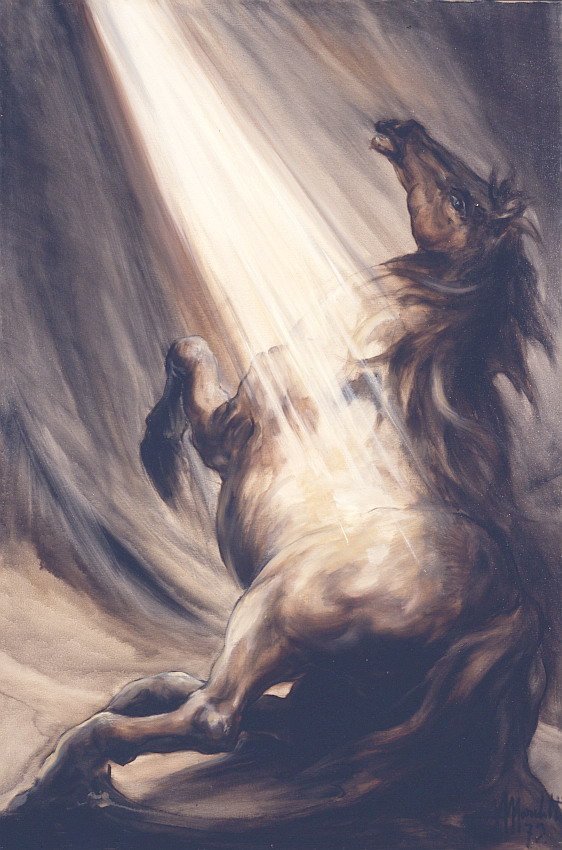

"Untitled"
Oil on canvas, cm.40x30 (Cat. 1343)
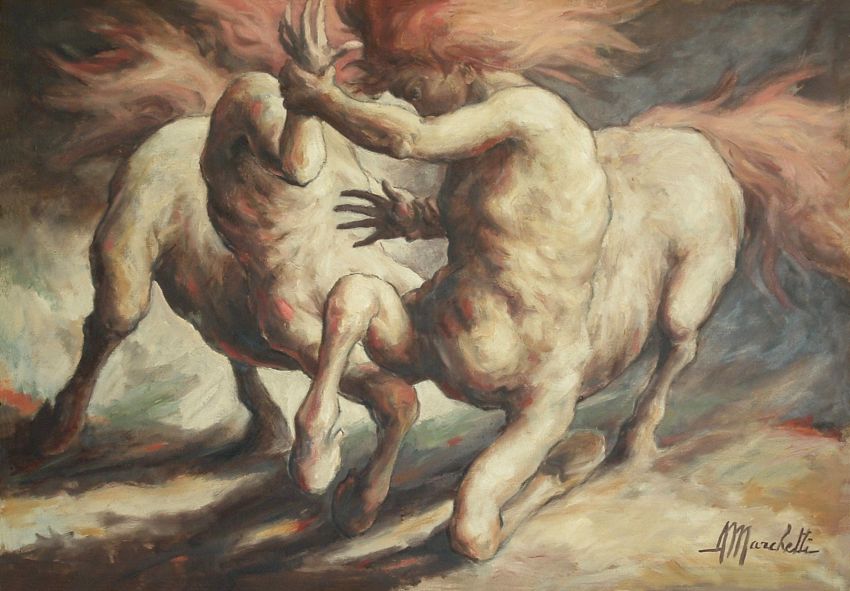
"Battling Centaurs"
Oil on canvas, 70x100 cm. (Cat. 1216) Private collection AM

Untitled"
Oil on canvas, cm. 80x120 (Cat. 1237)
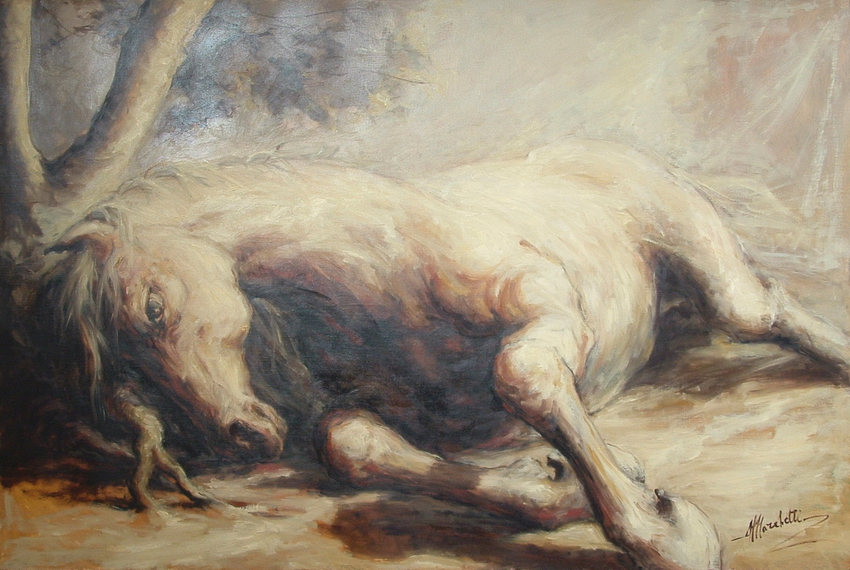
"Untitled"
Oil on canvas, 80x120 cm.(Cat. 1233)

"The Four Horsemen of the Apocalypse"
Oil on canvas, 1978, 80×120 cm. (Cat. 1337) Priv. coll. AM

"Every Man's Battle"
Oil on canvas, 1978, 70×100 cm (Cat. 1241)
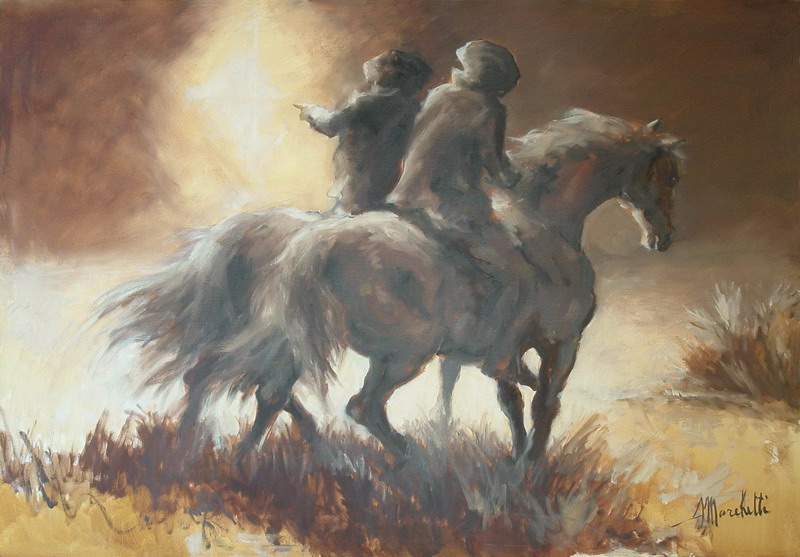
"The Ninth Hour"
Oil on canvas, 1982, 70×100 cm (Cat. 1283)

"Armageddon"
Oil on canvas, 1975, 60×80 cm. (Cat. 1275)
Text by the Association (ADAAM) - not independent criticism.
The work belongs to the figurative cycle. Human figures are present, yet here it is the animal, the horse, that sets the governing context: not as an iconographic motif but as the measure of space itself. The scene is not held together by any architecture regulating its proportions; it is built through the juxtaposition of bodies and a few flat planes that overlap by contrast of value, without converging on any single point. The fulcrum is the rearing white horse, recognizable through an interruption rather than through its slightly off-centre placement: the raised forelegs touch nothing, and the movement hangs suspended at its apex, without resolution. At first glance the viewer may expect the vision of a charge, but even a moment's attention reveals a stillness instead; and the entire reading rests on this suspension. What takes place is not a clash but a revelatory pause, the instant in which a figure halts at the centre of the generated world and makes itself visible to those immersed within it. The pale rider performs a single act: he holds the vertical. Where every other head is bowed and every other back is curved, his torso stays upright and his featureless oval head rises as a fixed point along the animal's axis. The absence of physiognomy does not make him anonymous; it makes him unindividuated, not a character but a condition. He is the man who has recognized his own origin, and for that very reason he has no features left to display. The animal that bears him is knowledge, and the relation between the two is one of adherence, not of dominion: the one who knows does not tame knowledge, he rides it. No weapon, no banner, no gesture directed at an adversary. The rider does not summon to battle; he urges awakening, and the only signal he emits is his own standing in light while all around him sinks lower. Read as a whole, the painting has been deliberately interpreted in a gnostic key, and what it offers is not a doctrine to be transmitted but a sleep to be broken: here no content is taught, an origin is to be remembered. The dark rider on the right works as a hinge between the central light and the edge of the painting; he is the last figure to retain a distinct profile, and he is losing it: the back curves, the head aligns with that of the horse, the body turns toward the margin and toward the ground. His is a posture of protection, and in the logic of the canvas protection means subtraction; here, sheltering from the light amounts to re-entering the common body, and the defensive gesture is already a relapse into oblivion. How far that descent reaches is shown by the lower band of the canvas, where no figure can any longer be separated: heads, haunches and limbs interweave into a single fabric, with no voids of ground and no gaze lifted upward. The compositional task of that mass is to add weight, to anchor the painting below, to keep the central light from spreading. Meaning follows function: persistence in earthly life as a condition of massing together, where the refusal of the light is not a declared choice but inertia, a shared torpor, belonging to the world that the lower entity has shaped, exactly as the gnostic vision foresees. The city on the height closes the field above: a near-flat silhouette, its depth barely suggested by the brushstrokes that form the structure's shadows, without openings, no destination but a boundary, a shelter offered to those who remain below. Set higher than the illuminated rider, it reverses the expected order: custody at the top, revelation at the centre, and the two do not coincide. The wall that reassures is the same that confines, the enclosure of the lower world from which the light does not come. A mute city, a silent rider: he is the canvas's only utterance. Across the work as a whole, colour operates as a regulator of temperature and of load. The range narrows to ochres, burnt earths, cold browns and milky whites, with no foreign accents or complementaries to introduce conflict; hence the stillness. Where the tone does not vary the motion does not propagate, and the rearing remains a circumscribed event, a light that does not spread by contagion. The register is symbolic and esoteric, and its key is revelation, not conclusion. The composition does not depict an apocalyptic event or a battle between hosts; it illustrates no text, announces no judgment, promises no ending that would set things right. It shows a separation that has already occurred between those who have risen and those who remain massed together, and it leaves it without outcome, because within the perspective that governs it awakening is not a reward: it is a recognition, and one that concerns a single person at a time. Note. Angelo Marchetti was a man of fervent Roman Catholic faith; the gnostic reading proposed in this interpretation does not represent a profession of belief on the artist's part. The contrast, however, is only apparent. The "remembering of an origin" and the awakening that the work stages do not deny that faith; they render its core in symbolic form: the man who recognizes where he comes from and returns to that source. What the gnostic vocabulary calls origin, Christian language names creation in the image of God and return to Him. Different interpretive instruments for one and the same movement of the soul toward its own principle.English translation produced with the aid of artificial intelligence.

"The Source of Life"
Oil on canvas, 1980, 40×30 cm (Cat. 1186)

"Untitled"
Oil on canvas, 1980, 80×100 cm (Cat. 1225)

"Untitled"
Oil on canvas, cm.30x40 (Cat. 1344)