


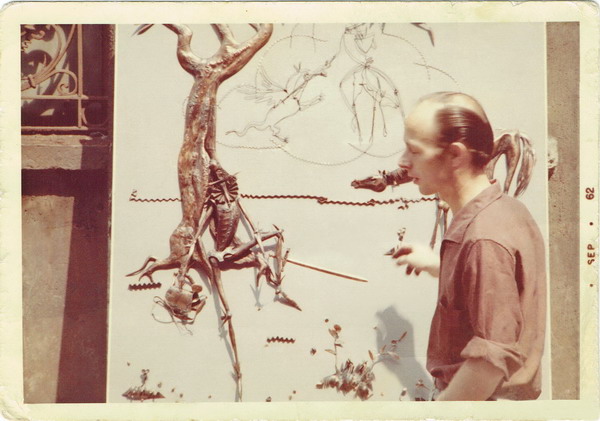
 Angelo Marchetti was born in Milan on 10 January 1930 and registered with the civil registry the following day. His formation took place in a city that, in the years after the Second World War, moved between material reconstruction and cultural unrest, a context that left a deep mark on his path.
From the very beginning, his trajectory defined itself by contrast. His family circle steered him towards commercial studies, with the aim of placing him within the continuity of his father's business, a small artisanal concern engaged in sheet-metal work. In parallel, however, a less containable impulse emerged: an expressive need that found no room within the expectations imposed upon him.
Already in adolescence Marchetti showed a marked artistic bent, producing engravings on sheet metal and small sculptural pieces in his father's workshop. Recognition of this inclination came at first from within the family: a paternal uncle, who gave him his first paints and so allowed him to approach painting. Even so, the family environment remained unable to understand or support this direction, giving rise to the first existential fractures.
The sheet-metal workshop had been founded by the artist's paternal grandfather, who built it into a thriving business employing a number of workers: before and during the Second World War its output of sheet-metal components reached considerable volumes. At the end of the war the business passed to his son, the painter's father. By the second half of the 1950s, however, it began a gradual decline: changing industrial requirements and the spread of plastics brought about the demise of traditional metalworking, stripping it of its economic centrality.
As he passed into young adulthood, his father's wish to settle him permanently into the business came into conflict with his own personal search. It was in this gap that the first conflict took shape not merely professional but inward. Marchetti refused an already-mapped trajectory and chose an uncertain field, developing his own language as a self-taught artist through a direct confrontation with matter and with experience.
From the late 1950s he moved in the circles of the artists and painters of the Brera district, among shared art studios, workshops and meeting places. In those years Brera was turning from a working-class red-light area into the heart of Milanese bohemia, so much so that it became known as the "Milanese Montmartre": a quarter where one met not only painters and sculptors, but also photographers, writers and poets, film directors and actors, journalists, architects and designers, who in its cafés and taverns gave rise to a cultural milieu that cut across disciplines. It was in this setting that Angelo came into contact with the artistic climate of the city, and in this same setting that he found the means to support himself: having deliberately distanced himself from his family of origin, he worked as an interior decorator, a trade adjacent to the circles he frequented and one that secured him a relative degree of economic independence.
The result was a life divided between practical necessity and artistic research; a research that steadily intensified and grew ever less compatible with an ordinary daily routine. For this reason too, although he frequented those places and formed friendships with artists engaged in political and cultural life, he kept to a lateral position: he shared their conversations and their restlessness, not their militancy. He joined no defined movement and sought no affiliations. His presence remained discreet, marked by a distance that was at once a choice and a necessity: he observed, he absorbed, but he could not be traced back to any shared formal system.
In the early 1960s he acquired a small space in Via Giovanni Raiberti, in Milan, turning it into his own studio, which he would leave in 1972; over time a succession of other workshop-spaces for his work would follow, but it was the working environment of Via Raiberti that allowed him to devote himself to painting as his principal means of support, with some economically favourable phases as well. This place became the centre of his activity, a space of work and exchange in which he consolidated his artistic identity in dialogue with other artists and with the debates of the day.
Over the years, his research turned increasingly towards an introspective dimension. Painting, sculpture and engraving on sheet metal took shape as instruments of inquiry, directed not at representation but at the understanding of an inner state. The works render tensions and questions, inscribing themselves within a continuous reflection on the themes of existence—without definitive resolutions and characterised by an unbroken process.
In this context, and partly through his frequenting of Milanese artistic circles, Marchetti drew closer to studies of an esoteric character. Such interests remained marginal and not explicitly declared in his production, yet they helped to direct his gaze towards less evident dimensions—deeper, and not readily reducible to any immediate reading.
With the establishment of his art studio, Marchetti devoted himself entirely to his artistic activity. Alongside the direct sale of his works was the activity of two art dealers, operating in different contexts, who supported their circulation.
As time passed—and following a diagnosis of intestinal cancer (overcome successfully after some years), which marked Angelo deeply in both body and spirit—a progressive withdrawal from social life grew more pronounced, with a thinning of his relationships and a reduction of his public presence. Though sustained by the continuing sale of his works, Marchetti built no career along traditional lines, nor did he systematically seek visibility or recognition. His trajectory remained secluded, consistent with a disposition inclined towards introspection and inquiry.
His path was marked by a persistent restlessness, by a tension that does not resolve but renews itself, taking the form of a search never brought to peace. The work thus presents itself not as an answer but as a passage: a space in which the question of the meaning of existence remains open, without definitive synthesis.
Angelo Marchetti died in Milan on 02 October 2000 of acute myocardial infarction, leaving a body of work that bears witness to a coherent and secluded path, marked by a constant tension between the visible and the invisible, between form and questioning. A production that does not offer itself at once, but asks for a gaze willing to dwell in disquiet.