Antonino De Bono - "Il Vertice" gallery, 1977
 "The distinctive trait of Angelo Marchetti is to confer upon his pictorial undertaking a mystical impulse of love, to permeate his images with a fine luminous fabric, to set the spiritual essences vibrating, together with the bodies thrust forward as the vanguard of life, within irrational atmospheres laden with metaphysical tensions.
He is the artist par excellence who identifies himself with the Ariostan verse, without rhetoric or false literary trappings; he is the singer of those \"ladies, knights, arms, loves, courtesies, bold deeds..." narrated with poetic impetus and visionary enthusiasm, having as his goal not the epic celebration of history but the exalting nostalgia for a lost Apollonian civilisation, for an extraordinary unfolding of legend that hovers in a pre-logical and timeless age.
Mythic knights, sturdy and clad tight in robust armour, their heads enclosed in kettle-helms or sparrow-beak or conical bascinets with cheek-guards, lances couched, set out to conquer turreted cities magically suspended in the air as in a mirage.
Bodies of heroes and titans, of warriors and workshop labourers, in unexpected solutions, emerge from the depths of the centuries or rise from the bowels of our own time: sculptural, volumetric, bearing in their flesh the transfiguring Luciferian ardour of enthusiasms for ideal revolts carried out with divine boldness.
Horses with a feral gaze, snarling and fiery in action, sprung from the cosmic wounds of time like frenzied images of the ancient Dionysian tragedy. How perfect, prancing and rearing in its fall, is the steed that unseats the apostle Paul, struck down by the Redeemer on the road to Damascus. Its hooves are sunken, delirium in its sockets, slavering sweat on the velvety skin, arabesqued with the glimmering tints of night.
Luxuriant the female nudes, gathered into the arch of the back; voluptuous the forms evoked in a continual Hellenistic striving, as a recovery of the "Lysippan" and "Praxitelean" motifs of closed rhythms drawn together as compositional units.
What pleases, then, in Angelo Marchetti is the phenomenal doubling of the being tossed between reality and fantasy, enraptured between allegory and myth, raised to a symbol at times within the harsh social condition, the event always related to an inventive conception that breaks away entirely from tradition to rise to a cosmic, "expressionistic" moment of the pictorial effect.
The artist loves to confer upon his works a transfiguring amber colouring that calls forth romantic solemnities, inspired by a shrewd play of raking light, by the shivers that the landscape and the surrounding space give off, kindling warm vibrations that wind off into the infinite, delighting in themselves the balanced masses, the bodies of men and animals, the compositions witty and rich in ancient wisdom ("The Grape-Harvesters," "Harlequin and Pierrot," "Every Man's Struggles," "The Habitat," etc.).
The sense of drama prevails in his work, the awareness of feeling and of passion, of sorrow and of sin, of redemption and celestial rapture: a procession of characters, of invocations, of allusions, of interweavings rises from the "human comedy" brought out by Angelo Marchetti with "Aeschylean" rapture. As if to hear the "suppliants," the "throngs," the "choephoroe" and the "corybantes," as in Greek dramaturgy, advancing, narrating, beseeching with poetic sensibility.
"The Death of Abel" belongs to this sublime Panic exaltation of tragedy, as the martyr's muscles crumble and his fingers turn to dust and fix themselves to the earth; "The Madonna with the Divine Child," austere and melancholy, fruit of the mystic rose, emerged from a suffused murmur of tones.
Everywhere there predominates a convulsed, orgiastic, obsessive nature, a source of corpuscular rays, of chiaroscuro effects vigorous and softened with emotion.
Superb, an interpreter of horses in struggle, desperately flung into their last gallop. Composed, prepared, subtle, dazzling in the graphic line, with a mordant sense of irony and satire.
A painter of vivid imagination, noble in the fluency of his images, of fluid and soft touch, of perfect draughtsmanly framework without neoclassical affectation, Angelo Marchetti enjoys a well-deserved renown for his spontaneous vein, rich with a vital sap saturated with an eternal luminism."
Antonino De Bono was an art critic, journalist, publicist, expert appraiser and consultant to the Court of Milan, as well as managing editor of the specialist magazine Arte più Arte and author of works of nonfiction and military history.
English translation produced with the aid of artificial intelligence. The authoritative text is the Italian original.



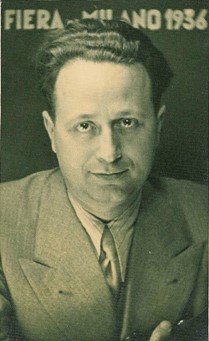 "In the drawings and paintings he showed at the Galleria La Cripta (1971), Angelo Marchetti revealed his commitment to making us feel man straining in the effort to free himself from the weight and constraints of matter, in the attempt to recover the pure spirit from which he was born. The graphic discourse of the drawings is conducted with the contour line alone, to mark the expression of the figures, while in the paintings the artist avails himself of every means, (strong drawing, daring perspectives, vivid contrasts, vibrant colours, tightly knit compositions) to prove the more effective.
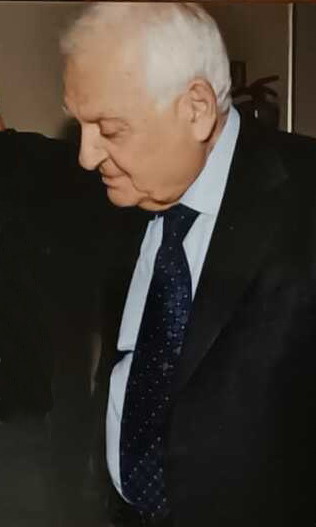 "More than figurative exhibitions in the traditional sense of the term, Angelo Marchetti's compositions are events that lay out spiritual forces in antagonism with one another.
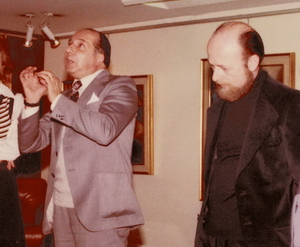 "The distinctive trait of Angelo Marchetti is to confer upon his pictorial undertaking a mystical impulse of love, to permeate his images with a fine luminous fabric, to set the spiritual essences vibrating, together with the bodies thrust forward as the vanguard of life, within irrational atmospheres laden with metaphysical tensions.