"Untitled"
Oil on canvas, 100x70 cm (Cat.1078)
Text by the Association (ADAAM) - not independent criticism.
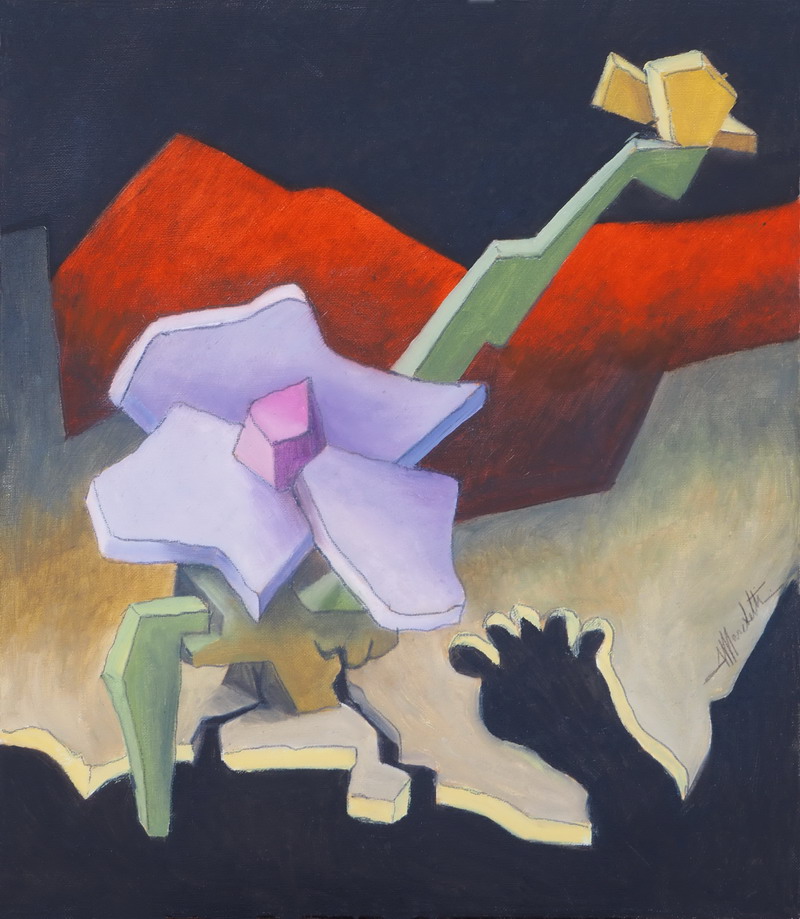
Visual DescriptionThe work presents itself as a claustrophobic yet suspended interior, constructed according to a rigorous geometry of symbolic intent. The scene is bounded by two wall planes: the front wall, of a warm and textured ochre, and the left side wall, darker, with a window fitted with a metal grille, while the acid-green floor, chromatically dissonant, marks the threshold between physical space and imaginary space. At the centre rises a yellow anthropomorphic figure, with a long, sinuous stem yet of clear human reference, around which, at mid-height, an organic purple and mauve hand with spiked nails takes shape, in a suspended gesture that materializes as an extension of the voice issuing from a telephone receiver. On the right wall three elements are arranged in sequence: a coat rack with an empty sheath, light brown in colour, analogous to the central figure but hollowed out; a second static image, that of a black top hat hanging from a metal hook. On the same wall the black telephone with the receiver left hanging in the void; a small white sheet with illegible annotations. Below, a broken green floor allows a telluric space of blacks and deep reds to surface, while the red ceiling compresses from above. The signature, Marchetti, is in the lower right. The meaning of these elements and of their relationships is examined in depth in the critical analysis that follows.
Critical Analysis
This work belongs to the cycle that studies on the artist place within his mature surreal-metaphysical research, the one in which Marchetti ceases to illustrate and begins to construct psychic landscapes: environments that do not exist in the visible world but which describe with millimetric precision inner states, conditions of being, unresolved tensions between irreconcilable planes of reality. It is important to bear in mind that the artist explored themes linked to esotericism.
The fulcrum of the work is the yellow anthropomorphic figure that rises at the centre of the space. It is a body, reduced to the essential, elongated into a sinuous stem that culminates in a bowed head. That reclined head is the key to the entire composition. It is not the triumphant verticality of one who ascends, but the posture of surrender, of listening, of submission to the event; the gesture of one bent by a weight (here the fulcrum within the context of the work) and gathered into himself.
The yellow, with the barely hinted shadow of green, does not convey the warmth of light and vital energy as the warmth of yellow should, but the addition of green as shadow renders it static, cools it, and the yellow colour is here assigned to a single form, isolated, slender, that persists standing in an immobility emphasized by a single foot that grants no movement, still less a way of escape, but only stability held motionless while all around urges it downward. The figure is alive, but its life is a laborious verticality, not an exultation.
Around the body, at mid-height, the organic hand of purple and mauve tones takes shape, with nails reduced to spikes ready to grasp. Its ambiguity is deliberate: the gesture is begun but not concluded, suspended in a clasping that does not tighten, in a threat that for the moment does not attack. The force of this image lies in its origin: the anthropomorphic hand is not autonomous, but materializes as an extension of the telephone cord, as the visible substance of a voice. Marchetti here performs a typically metaphysical operation: he gives body to the incorporeal, renders sound into matter, transforms a communication into a physical presence that surrounds and conditions the figure. What issues from the receiver is not a word: it is a psychic entity, a pressure, a hand that seeks to hold back.
The system of the right wall completes this dramaturgy of incommunicability. The black telephone, heavy, is the source from which the entire dynamic is generated; the receiver lifted and abandoned in the void fixes the exact moment in which the conversation was interrupted or remains awaiting a reply that will not come. The small sheet with illegible annotations reinforces the reading: something was written, thought, kept, but remains hermetic, untransmittable. Knowledge is present in the space, but inaccessible.
The coat rack introduces the work's most stark counterpoint. From it hangs an empty sheath, a form analogous to the yellow figure but hollowed out, reduced to a shell. The sienna colour — light brown — communicates what is spent, withered, and declares its irreversible condition: it is what the central figure risks becoming, or what it has already been… Marchetti thus places, on the same canvas, two states of the same being: the form still alive and taut in its bowed head, and the inert remains hanging on the wall like a discarded garment. Between the two, the space becomes the theatre of an announced farewell.
The lower band confirms this tension towards the bottom. The green floor, broken and irregular in its residual profile, no longer offers a stable support: it shatters, allowing a glimpse beneath of a dark space of blacks, deep reds and oxidized browns, a telluric emergence that threatens from below the plane of existence. The yellow figure stands on a threshold that is crumbling. From above, the red ceiling compresses with its flat and unequivocal band. The dark mass presses from below, the chromatic pressure weighs from above, the hand-voice envelops in mid-air: the figure, in the middle, resists, but it is a resistance played entirely on the edge of the bowed head.
Marchetti's art is not a sterile mirror of reality, but a door towards profound dimensions of the psyche and of transcendence. In this canvas, that door is built with humble means, a slender body, a telephone, an empty sheath, a floor that gives way, but it is a real door.
The work does not illustrate an allegory: it inhabits a liminal space in which the visible datum is a pretext for naming what ordinary language cannot reach. The figure with the bowed head neither ascends nor falls: it remains suspended in the moment in which form questions its own destiny between the matter that holds it back and the spirit that calls it. It is, in the most rigorous sense of the term, metaphysical painting.
English translation produced with the aid of artificial intelligence.