


The mature poetics: the conception of art as a spiritual vocation, symbols, visual language, the relationship between form and transcendence.
Angelo Marchetti's creative identity rests on a radical conviction: art is not a description of the visible, but an inquiry into what the visible conceals. Painting, sculpture and engraving were for him instruments of one and the same search, directed not at the rendering of reality but at the understanding of an inner state. In this fundamental choice lies the coherence of a secluded and unbroken path.
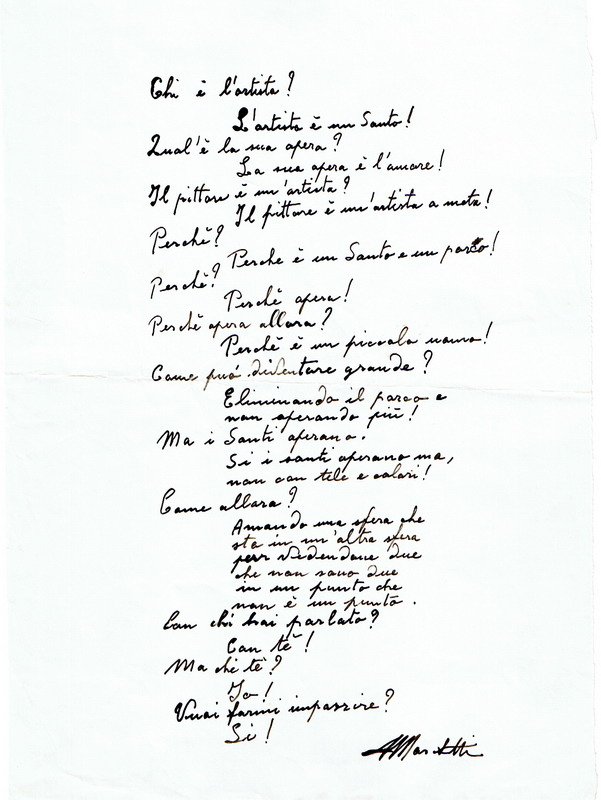 Art as vocation.
For Marchetti, creation was not one trade among others, but an all-consuming vocation, inseparable from his own identity. The creative act held for him the priority of a primary need, placed before every other urgency. This absolute conception of art explains the devotion with which he gave himself to it and the naturalness with which he refused conventional models of a career: he did not systematically seek visibility or recognition, letting the work speak rather than its promotion.
This vocation was accompanied by a conception of art as a spiritual and moral act before a technical one. Marchetti felt acutely the tension between the loftiness of the end and the concreteness of the means—between absolute aspiration and the limits of working with canvas, colours and matter. Hence a relationship with his own practice lived as a search never brought to peace, as a passage and not a landfall.
Form and transcendence.
His painting, rooted in a figurative vision, does not confine itself to representation: the figure, the face, the scene are traversed by a light that exceeds the naturalistic given and alludes to a vaster, almost metaphysical dimension. In this balance between form and symbol the work becomes a kind of visual philosophy, in which every mark and every colour constitutes a step towards an experience of meaning.
His is a figuration that asks the viewer not to stop at the "how," but to question the "why."
Over the years his research turned ever more towards introspection, until it shaped the work into a space of resonance in which the vision of the world and that of the soul coincide. Within this horizon the painter is not merely a maker of forms but—in a formula that aptly captures his stature—an explorer of being, attentive to the mystery of life and to the possibility that colour and image hold a cognitive value as well as an aesthetic one.
A language of symbols and of light.
Marchetti's imagery is rich and coherent, built around a few stable figures that recur like a personal grammar. Light there takes on the value of knowledge and inner life; the elements of nature are charged with a consolatory and spiritual function; the tension between fragility and hardness becomes a metaphor for the inner condition. His sensibility is first of all visual and chromatic, yet it can also become a perception of sound and touch, in a conscious distinction between looking and listening that belongs to the gaze of a true painter.
A search without synthesis.
Marchetti's creative identity is recognised, in the end, in a restlessness that does not subside but renews itself. The work offers no answers: it keeps open the question of the meaning of existence, and for this very reason does not yield to an immediate reading. It calls for a gaze willing to linger, able to take in the tension between the visible and the invisible as the very place where art comes to pass.