


Marchetti the writer: writing as confession, thought by way of aphorisms and illuminations, the relationship between word and painting as two paths of the same search.
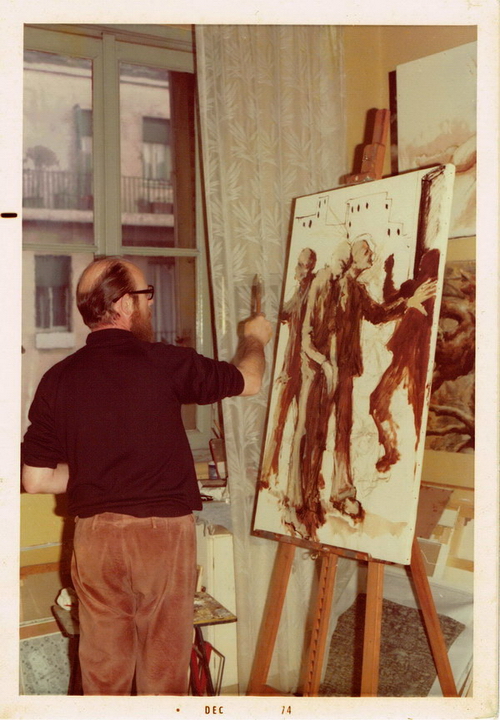 Alongside canvases, sculptures and sheet metal, Angelo Marchetti left a substantial corpus of writings: poems, reflections, prayers, aphorisms and short prose pieces. These texts are not a marginal activity with respect to his painting, but its natural extension: the place where the very inner search that governs the figurative work finds a direct voice. To give the floor to the painter is to hear that search in its most immediate and confidential form.
Writing as confession.
For Marchetti, to write was first of all an act of truth towards himself. The page became a space of inner examination and, at the same time, an expressive outlet: faith and doubt, love and despondency, praise and self-accusation were all deposited there. More than texts intended for publication, many of these writings have the character of a confession, in which emotion is uttered without filters and reflection becomes at once an unburdening and a prayer.
The style faithfully reflects this origin. The writing proceeds by short, broken sentences, by repetitions and exclamations, with an often vertical movement that isolates the single word and charges it with weight. It is a paratactic and intense language, run through with second thoughts and corrections that allow a glimpse of the working of thought in the making.
Thought by illuminations.
On the level of content, Marchetti favours the striking formula over sustained argument. His thought tends to condense into maxims and aphorisms, into concrete images from which he draws a moral truth, by a procedure closer to the parable than to the treatise. He readily resorts to paradox and reversal, and builds by oppositions: good and evil, light and shadow, fragility and hardness. When he takes up a more extended reflection, he nonetheless preserves this pace of intuitions, in which illumination counts for more than demonstration.
Between word and painting.
The writings and the works share the same thematic core: faith, love, solitude, time, the meaning of existence. The word, however, illuminates a region of it that painting tends to hold back. If the figurative work alludes and safeguards, the written text declares: vulnerability, the need to be understood, the relationship with transcendence all surface in it with candour. For this reason the texts examined represent a precious key to interpretation, able to render the artist's thought in a first-person voice that integrates and completes the visual language.
The writings also gauge the conception that the man-artist had of his own role. Within them coexist the humility of one who knows himself small before the mystery and the awareness of a lofty vocation, in an oscillation that is itself part of his identity. The word, then, does not merely comment on the work: it reveals its deeper motivations and confirms its nature as an existential search before an aesthetic one.
Note: The texts referred to here come from the artist's archive and are largely private in character. They are presented as a direct testimony of his inner world, with respect for their nature as intimate writing, not originally intended for public circulation.
A selection of these texts will be published on this web portal in due course.