


"Untitled"
Oil on canvas, 1969, 100x70 cm (Cat.1327)
Text by the Association (ADAAM) - not independent criticism.
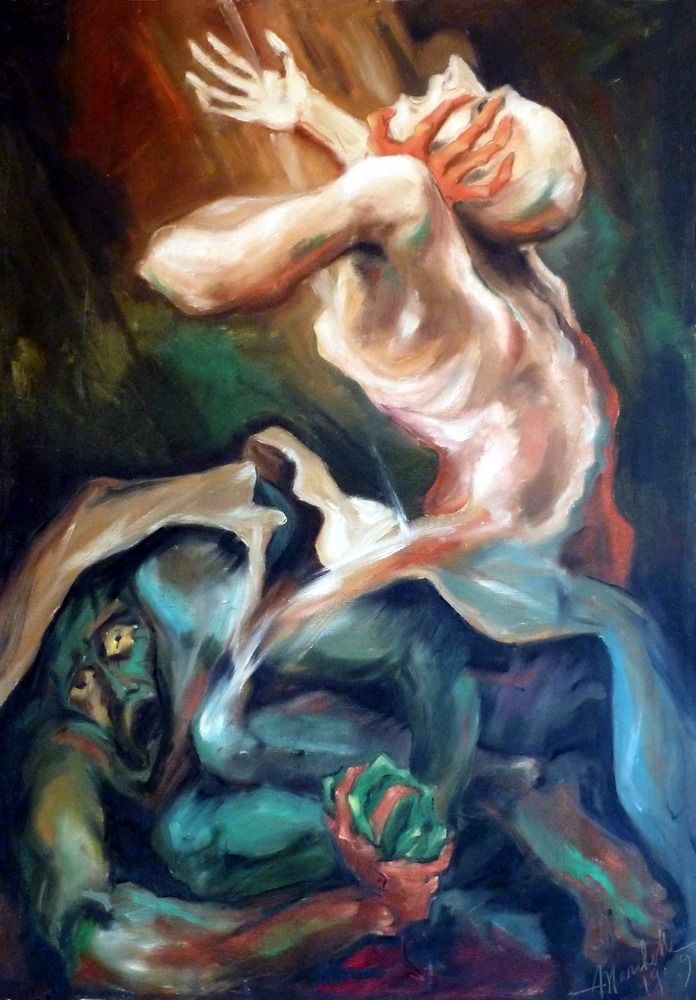
The work belongs to the cycle of the “black” paintings, and its reading begins from what that “black” does to space: there is in fact no defined background, only a dark, subterranean, primordial depth. Space arises not from perspective but from pressure, and dimension is given by the matter in the foreground, where two figures, distinct at first glance, instead reveal themselves to be a unity on the verge of separation, not yet accomplished.The pivot is the pale body that twists upward and opens its hand against the light. This is the key gesture: the canvas reads as a movement of extraction, a body that separates from another by means of what covered it. The forearm extended at the level of the face and the head flung back fix the direction; without that diagonal it would be a mere mass, with it a passage.
In the lower register lies the heavy, closed figure, in cold, earthy colours. It is a body in a foetal position: arms and hands encircle and clasp the gathered legs, the head sunk low, the eyes large and yellow, the mouth open but voiceless. Within the composition it is ballast: it occupies, it holds, it anchors to the dark; it remains uncertain whether it shelters, protects itself, or recoils from what is happening, and thus from the figure above it: its pose does not decide. In a Gnostic key it is imperfect man enclosed in the ignorance of his own being; but before meaning, what counts is function: to impede, to contain, to weigh.
Between the two lies the casing, and it is best left undetermined: a pall, a cloth, a shell of stone, something that wraps in order to contain; yet from a crack in it the pale figure emerges, as if what was containment gave way to what it contained. Whatever it may be, its function stays the same: it encloses the lower part and separates it from what pushes to get out and, at the same time, it is the point at which that closure gives way: it holds back and, together, lets go.
The emerging figure is the opposite of the gathered one: it is born from the same block, already formed in the raised hand and the bald head, still shapeless in the torso that surfaces from the mass. The emergence is painful, not complete: the reddish hand on the face holds it back, like someone clutching their head in incomprehension or astonishment. In a Gnostic key it is the return to self-knowledge, which comes after what the figure does: to take form, to rise, to reach toward the light.
The painting is made of contrasts that remain open, with neither prevailing. Below, a dark, huddled mass weighs down; above, a rift of light opens: it is fullness against the void. One part stays anchored to the depths, another pushes upward: the crouched body holds back, the other rises. The pale flesh is taking shape, and around it remains what kept it enclosed. Here nothing truly resolves: the rising body is still bound to the one below, and the light, though so near, does not reach it.
Colour is to be read as an operator, not as sensation. The dark greens and earth tones of the lower part, the same as those of the subterranean background, are cold and heavy: they lower, they immobilise, they induce stasis. The pinks and whites of the forming body grow warmer toward the top: they lighten, they set in motion. The red of the hand and of the upper edge brings a temperature that the lower part lacks. Temperature measures the possibility of movement: where it cools, the figure stays; where it warms, it rises.
In its register the work is symbolic, and here the Gnostic key governs its reading: a condition of being rendered as a relationship between two bodies. The artist himself, by his own vocation, would have preferred a Christian reading; yet the very possibility of a different interpretation is the proof of that universality which he left to the observer, free to read into it his own. In any case the message stays clear, whatever key is chosen. It is neither illustration nor narrative: it does not recount an episode, nor fix an emblem to be deciphered in a single sense. And it is not liberation accomplished: it holds its subject in the rupture, before the light takes him. It speaks the passage, not the arrival.
English translation produced with the aid of artificial intelligence.