Select your language

  • Italiano (it-IT)
  • English (United Kingdom)
  • +39 335-83.69.615
  • adaam.info@gmail.com
Angelo Marchetti - Pittore e scultore italiano del Novecento
  • Home
  • Works
    • Horses and Centaurs
    • Sacred Art
    • Black Works
    • Abstract on Canvas
    • Abstract on Paper
    • Abstract on Paper B&W
    • Figurative
    • Figurative - Sketches
    • Abstract Figuration
    • Nudes on Canvas
    • Landscapes on Canvas
    • Surreal on Canvas - Metaphysical
    • Surreal on Canvas - Mystical
    • Surreal on Paper - B&W
    • Surreal on Paper - Colour 1
    • Surreal on Paper - Colour 2
    • Mixed Supports
    • Repoussé on Metal
    • Works on Photography
  • The Artist
    • Biography
    • Thought & Vision
    • Writings
  • Texts and Commentaries
    • Critical Reviews
    • Annotated Works
  • The Artist in Depth
    • The Artist in Depth
    • The Man Behind the Artist
    • At the Origins of the Work
    • The Creative Identity
    • The Painter Speaks
  • Collectors contact
  • Project

Figurative

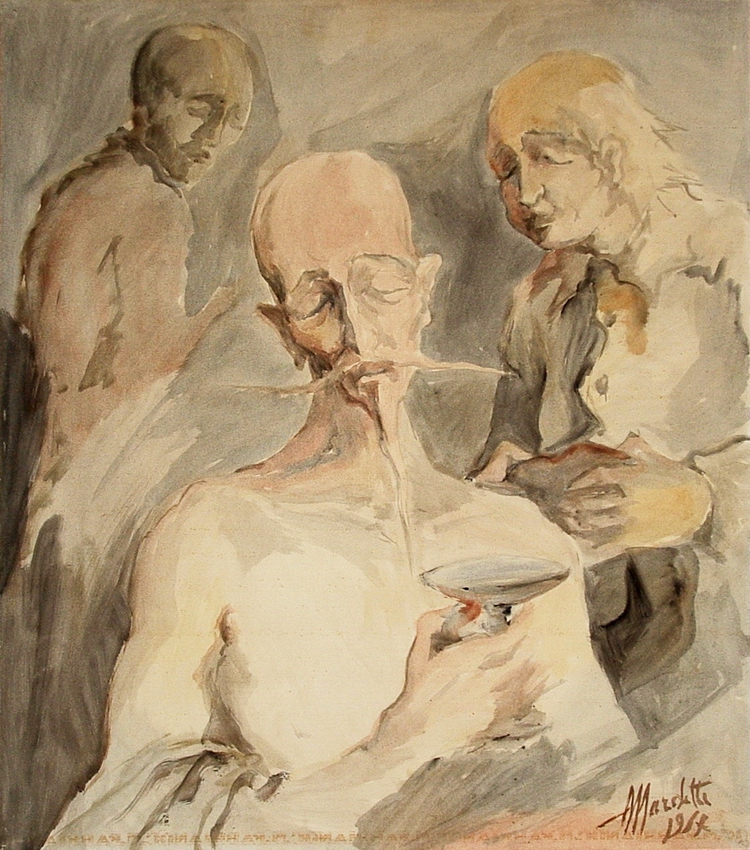
Don Quixote as a gaunt, bare-chested man holding a bowl, attended by two figures at his sides; watercolour in earthy grey tones, rapid textured brushwork.
Read the commentary

"Don Quixote"
Watercolour on Fabriano paper, 1967, 80×80 cm (Cat. 1235) Private collection GM

Text by the Association (ADAAM) - not independent criticism.

Visual description

Three half-length figures occupy a shallow space. There is no architecture: the ground is a field of unsettled greys and pale earth tones, without walls or horizon, and the planes are distinguished only by the overlapping of the bodies.
At the centre, in the foreground and set lower than the others, is Don Quixote of La Mancha. He is rendered here as a gaunt, bald man, his head slightly inclined to one side, his eyes closed, his neck long and taut; the torso is bare, of a pale complexion, worked over with earthy glazes. Over his left arm he holds a pale cloth, perhaps a shirt; his hands hold, a little above the height of the belly, a cup on a short foot, pearl-grey in colour. The expression is submissive and pensive.
Behind him to the left, a second standing figure, of a dark complexion, the head bowed and the eyes lowered towards the centre, the shoulder and arm barely indicated, is present there but anonymous, serving only as an ungainly onlooker.
To the right, set higher, a further figure with more defined features, probably the innkeeper he met at the tavern on his first journey as a knight errant across the plain of Montiel, a figure described by Cervantes as a peaceable man yet a thief and a swindler. Here he is, behind Don Quixote, where he stirs for the first time: dishevelled in the few hairs at the temples, the broad forehead a pale ochre, with half the face in shadow, his gaze directed downwards towards the cup. His left hand, in the foreground, offers Don Quixote a piece of dark bread; the garment falls away in cold greys to a deep brown, the darkest accent in the whole of the right-hand side.

The signature, in reddish brown, is in the lower right-hand corner, followed by the date 1967. Along the lower edge runs a pale band bearing repeated, barely legible marks, though in all likelihood it is the papermaker's watermark, impressed in transparency across the full width of the sheet. It is from these observable elements that a reading of the relationships holding them together proceeds.

Critical analysis

The work belongs to the artist's figurative research on paper, a domain in which line and colour build space by subtraction; no perspectival system governs the scene: depth arises from the bodies drawing close to one another and from the gradations of tone. The space is compressed and frontal, and the three figures do not inhabit a place but occupy a surface. This shifts the whole weight of the narrative onto the postures, for around them there is nothing to situate the scene in any determinate time or place. The central figure, then, is Don Quixote of La Mancha, and his posture is the key to the whole; bare in the torso, gaunt and submissive in the face, weary in the body, he holds the cup with his right hand and bows his head with a composure that no other figure here possesses.
Here lies the observation that orders everything else: precisely in his nakedness as a man worn and stricken, the knight sets himself apart from the two figures that flank him. Not by position — he stands lower and more exposed than they do — but through a nobility of spirit that passes entirely through the way he holds his neck erect and tilts his head slightly, the relaxed shoulders, and the hand that holds the chalice; the gentleness of the gesture separates him from the context rather than binding him to it. The two lateral figures, indeed, work by contrast, for they are coarser in manner and in posture: the one on the left looms, barely defined, without sharp contours, a presence that weighs more than it acts; the one on the right struggles to emerge as it offers the hunk of bread with a more cursive, more concrete movement, devoid of that measure which, in its difference, governs the knight. Their bowed heads converge toward the centre, but it is a convergence of lowered gazes — so much so that one senses the eyes are closed, and surely opaque — while Don Quixote's recollection remains of another order.
The triangle traced by the three heads is not symmetrical, and this asymmetry is not merely compositional: it holds the noble figure distinct from the two that attend him without reaching him. Around this distance the represented instant is organised. Thus the observer is led to look also at the cup, held at the centre just above the height of the belly: it is not at the geometric centre of the composition, yet it is nonetheless its dynamic centre. The knight's pale torso, broad and lightly worked, is a zone of quiet upon which the other presences lean, and the reclined head introduces the only true movement.
If the bared body in the foreground stands between two clothed figures — between one who receives with dignity and one who offers with a coarser hand — and if the eyes, and consequently the gazes, ought to act as lines of force, guiding perception through the scene and establishing its dynamic, in this drawing they are not the scene's impulse: the artist has withheld that dynamism, particularly in the figure on the right, which, besides failing to assert itself where its gaze ought to be directed, seems instead to want to hold back the exchange. The dynamism therefore passes through the gestures and not through the gazes: the scene remains on a threshold of silence.
Colour is to be read as function, not as atmosphere. The earth tones — warm ochre, diluted sienna, reddish browns, among the artist's favoured hues — gather where there is skin and life: the brow on the right, the shoulders of the figure on the left, the signature itself. The greys, cool and restless, occupy the ground and the garments, lending weight and stilling the scene. The ivory-white of the torso is not a colour but a suspension: the paper is left almost untouched, a luminous void that isolates the knight and confirms his distance from the darker presences surrounding him. The deep brown on the right and the shadow at the lower left act as counterweights, preventing the whole from dissolving into light. The cup, pearl grey, is chromatically neutral: it draws the eye not by colour but by position, consistent with its role as pivot.
The key to the work is metaphysical, in the sense in which Marchetti's research is: the figurative scene does not exhaust itself in the rendering of the visible but becomes an inquiry into the human condition. Don Quixote's nobility is not recounted through an attribute or a heroic gesture, but emerges by subtraction, from the contrast with the coarseness of those beside him; and the light that rises from the torso and the cup does not describe a setting: it points to something more vast. What we see is an act, a giving and a receiving around a cup and a food, but the circumstances remain off-frame. This is not a genre scene: the setting and the objects of daily use are absent, and every indication of place and time has been deliberately excluded; nor is there a portrait, for the faces are withheld or lowered.

Thus the artist gives form to a distance: that between the idealist Don Quixote and the sensible world that nourishes him yet without understanding him — the sensible reality that surrounds him and in which he seems immersed without fully belonging to it. Nel creare la figura centrale, absorbed and suspended, holding the cup like an entity suspended between appearance and what appearance conceals, Marchetti wishes the observer not to ask to recognise the "how" of things, but to pass through it in order to interrogate the "why" that their form conceals.

English translation produced with the aid of artificial intelligence.
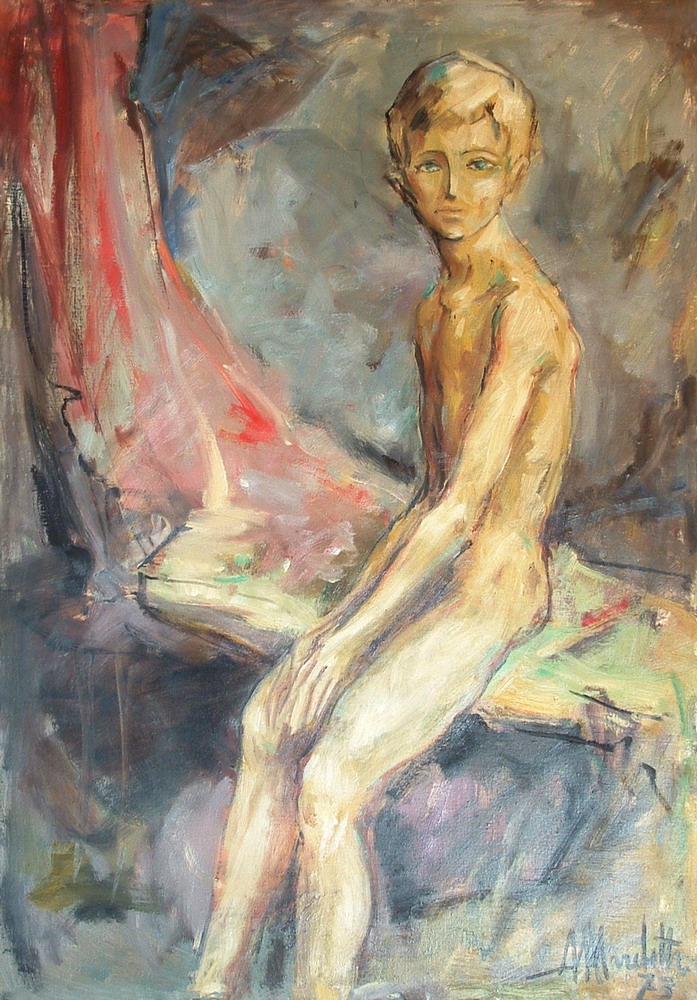
«Adolescenza», olio su tela di Angelo Marchetti: giovane figura seduta di profilo, volto rivolto verso l'osservatore, su fondo grigio-bruno, pennellata sciolta.

"Adolescence"
Oil on canvas, y. 1973, 100x70 cm (Cat.1277) Private coll. AM

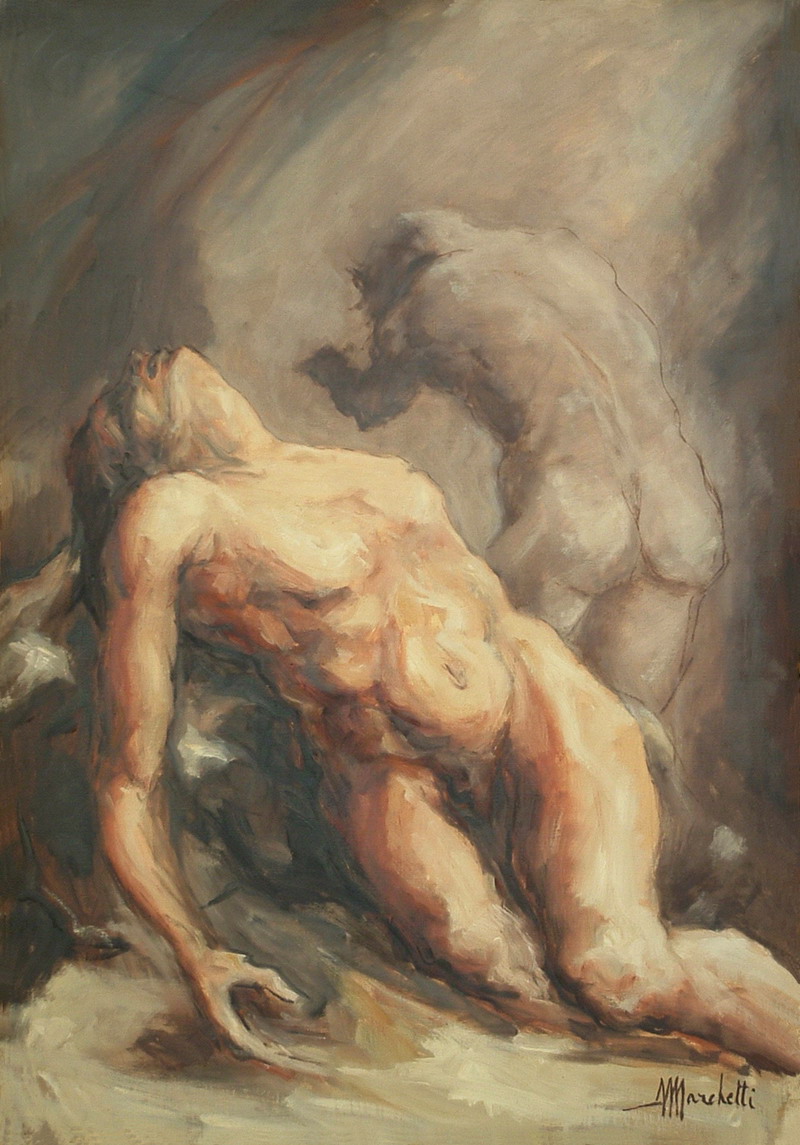
"Cain and Abel," a biblical drama here depicted in oil painting on canvas.

"Cain and Abel"
Oil on canvas, 100x70 cm (Cat.1223)

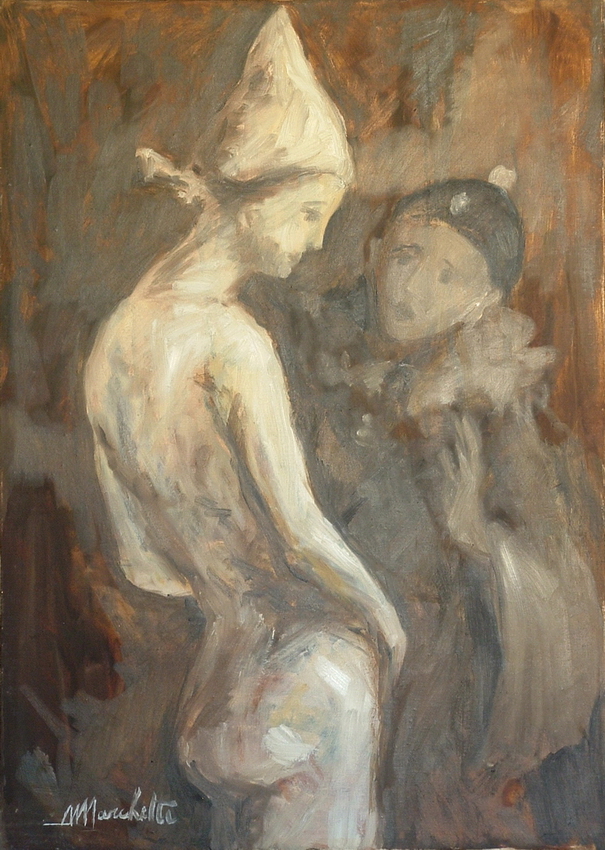
Two carnival-masked figures facing each other: a pale one in a tall pointed hat, a darker one with a ruff; oil on canvas in warm earth tones.

"Untitled"
Oil on cavas, 70x50 cm. (Cat. 1257) 

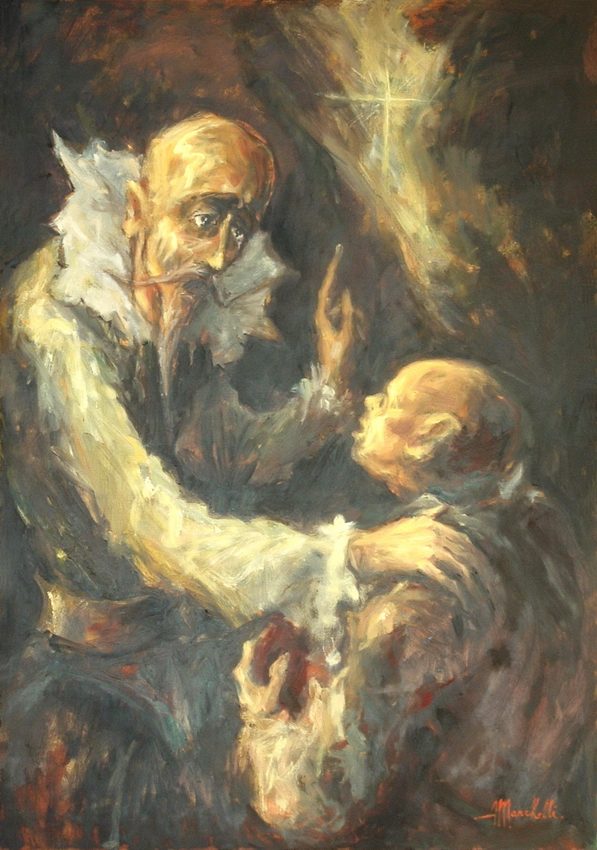
Don Quixote, gaunt and bearded, speaking with Sancho Panza, his hand raised towards a star above

"Untitled"
Oil on canvas, 100 x 70 cm. (Cat. 1220) Private collection AM 

"Self-portrait" by Angelo Marchetti: an oil portrait of an elderly man with a broad forehead and a beard, rendered in wide brushstrokes in tones of brown and ivory against an ochre background.

"Self-portrait"
Oil on canvas, 40x30 cm (Cat.243)

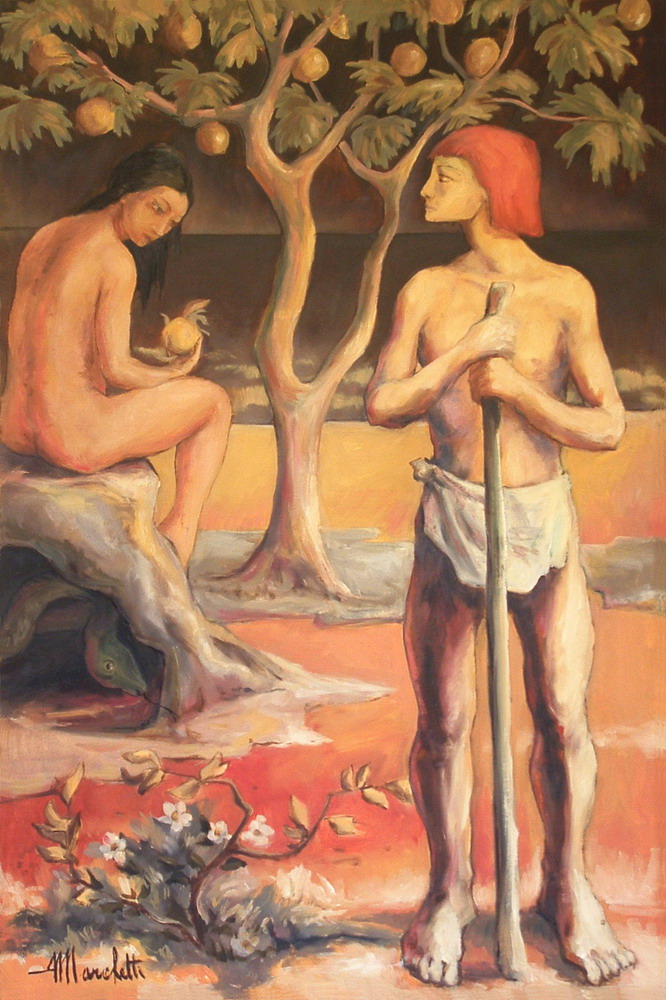
Adam and Eve, oil on canvas by Angelo Marchetti (Milan, 1930–2000): two nude figures beside a fruit tree with a serpent, twentieth-century figurative painting.

"Adam and Eve"
Oil on canvas, year 1977, 120x80 cm (Cat.1229)

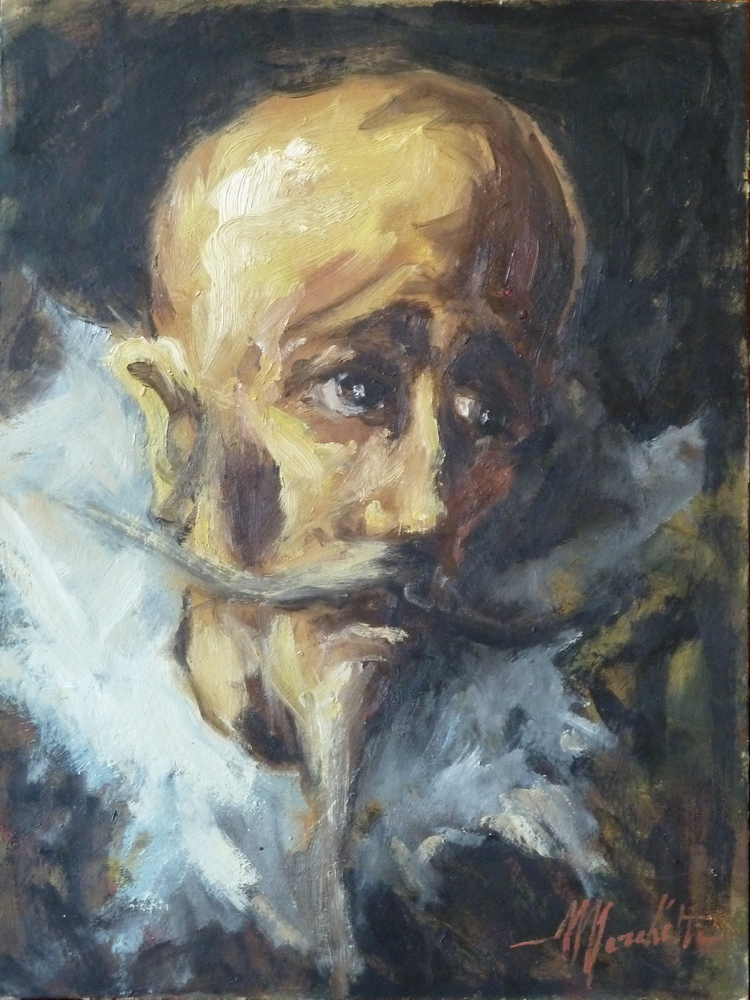
Angelo Marchetti, Untitled (k1342), oil on canvas 40 x 30 cm: portrait of Don Quixote, gaunt face with drooping moustache and wide white collar against a dark ground
Read to the analysis of the work

"Untitled"
Oil on canvas, cm. 40x30 (Cat. 1342)  

Text by the Association (ADAAM) - not independent criticism.

Visual description
The painting, upright in format, is given over entirely to a single figure seen close to, brought so far forward that it commands the whole surface; the crown of the head grazes the upper edge and the very tip of the beard the lower one.
There are no architectural planes, and the space is organised on two levels only: the ground, reduced to a residue, and the figure of Don Quixote, which occupies almost the entire field. What separates them is not a line but a shift in temperature and in density. The ground is an unbroken expanse of burnt umber and dull black, subdued rather than deep, laid in with lean glazes; it behaves as a closed plane, while the figure, worked in thick impasto, advances towards the viewer.
The head is the pivot. Turned three-quarters, inclined forward. The skull is bald and broad, painted in Naples yellow and lead white, the curved strokes following the crown and leaving the furrows of the bristles in evidence. The light falls from the left, and on the right the yellow turns to a reddish brown. The sockets sink into raw sienna and a very dark brown, at points close to black: the right eye is brought to finish, with a grey sclera and a white highlight; the other remains in shadow, yet legible. A muted brick red marks the right cheek. The nose is long and gaunt, its slight hump shaped by a single decisive stroke.
From the base of the nose spring two moustaches, drooping at first, then swept upward into fine handlebars, laid in with two continuous strokes of grey and ochre that carry the same light; both extend beyond the contour of the face. Below the chin falls a pointed beard which, with the moustaches, recalls the musketeer fashion, tapering as it descends. There is here a small incongruity, deliberate or at least accepted: Cervantes's novel slightly precedes the vogue for curled moustaches, and that musketeer cut belongs to the sedimented image of the knight rather than to his actual period. The painting does not correct the discrepancy but retains it: this is the face Don Quixote has assumed in collective memory, not the one he would have worn in a portrait of his own day.
About the neck and shoulders lies a broad crumpled cloth. The artist declined to make it legible as a ruff or as an open shirt with dishevelled folds: he assigned it no function beyond that of a base and a partial frame for the face. It is painted in white, bluish grey and faint ochre tints, in broad overlapping strokes; the left side is the more luminous and the more defined, again declaring the source of the light, while on the right the handling breaks up and merges with the shadow.
Lower right, the signature, brushed in brick red in a single cursive stroke.
A single dominant face, a mute ground, no object introduced for embellishment: it is on this distribution that the reading which follows rests.

Analysis of the work
The work belongs to the artist's figurative core, the phase in which space is not constructed but withdrawn. No perspective, then, no setting, no support: depth is obtained through tonal values alone, thickening the ground until it becomes impenetrable and bringing the figure forward by contrast of light. The choice carries precise consequences. The face does not sit within a place, it sits against a surface; and since nothing measurable surrounds it -no plane of support, no horizon line- its scale remains indeterminate, and with it the distance from which we regard it. Here the construction of the space and the construction of the head are one and the same.
The compositional focus is not the skull, which does occupy the greater part of the surface, but the gaze; more precisely, the disjunction between the turn of the head and the direction of the eyes. The head is turned to the right and inclined forward, as of one leaning out to look at something; the sunken eyes, sorrowful in register, impose upon the face a rhythm of mass and void that returns in the hollowed cheek. The interruption is minimal, a few millimetres of paint, and it is the sole torsion in the whole composition; for this reason it becomes the key to the ensemble, establishing that the figure is turned towards an outside that does not return its look.
Everything else works in the service of this exclusion. The skull acts as a receptor of light: it is the only full mass in the painting, and its continuous surface, hairless and therefore without incident, returns the illumination instead of absorbing it. The total baldness repays attention, being a decision of the artist's and not an obligatory given, for the illustrative tradition hands down a Quixote with the head covered, or with hair thinned but present. Here the head is wholly bare: it resumes the notion of the dry and the spare, which in Miguel de Cervantes is filled with an imagination made fervid by immoderate reading of the books of chivalry. The artist, however, anticipates the passage into the loss of reason: hence the expression of one who looks on with a sadness born of the old knight's approaching madness, exposed now to the adversities that surround him and that he here beholds.
A bald skull affords no shelter: it gathers the light as an object would, not as a person, and for this reason the figure appears more delivered up to our gaze than it is aware of being.
The eyes are the most finished passage, the mouth the most withheld: the spoken and the ineffable stand side by side within the same face. Here the man Don Quixote appears for what he is in the tale, not for what his fame has made of him. In this instant the artist discloses the fragility of Cervantes's hero.
Colour is to be read as a structural device, not as sensation. The range narrows to three families of yellows, which carry both the warm temperature and the whole of the luminous weight, concentrating it in a single zone. In its register the face remains that of the portrait, not of the illustration.
The work recounts no episode, displays no attributes, makes no mockery of the character. It relinquishes the armour, the lance, every sign that would render him immediately recognisable, and retains only a head and a gaze that meet nothing. It is not a caricature, and it is not a devotional image: it is the plain acknowledgement of a figure reduced to itself. Here Don Quixote ceases to be the madman of a novel and becomes anyone: the man alone with himself, aware of his own wretchedness and not, for that, prepared to disown himself.
To look at him is to look at ourselves: the bare head and the gaze that meets nothing are the condition of every man left alone with his conscience.


English translation produced with the aid of artificial intelligence.
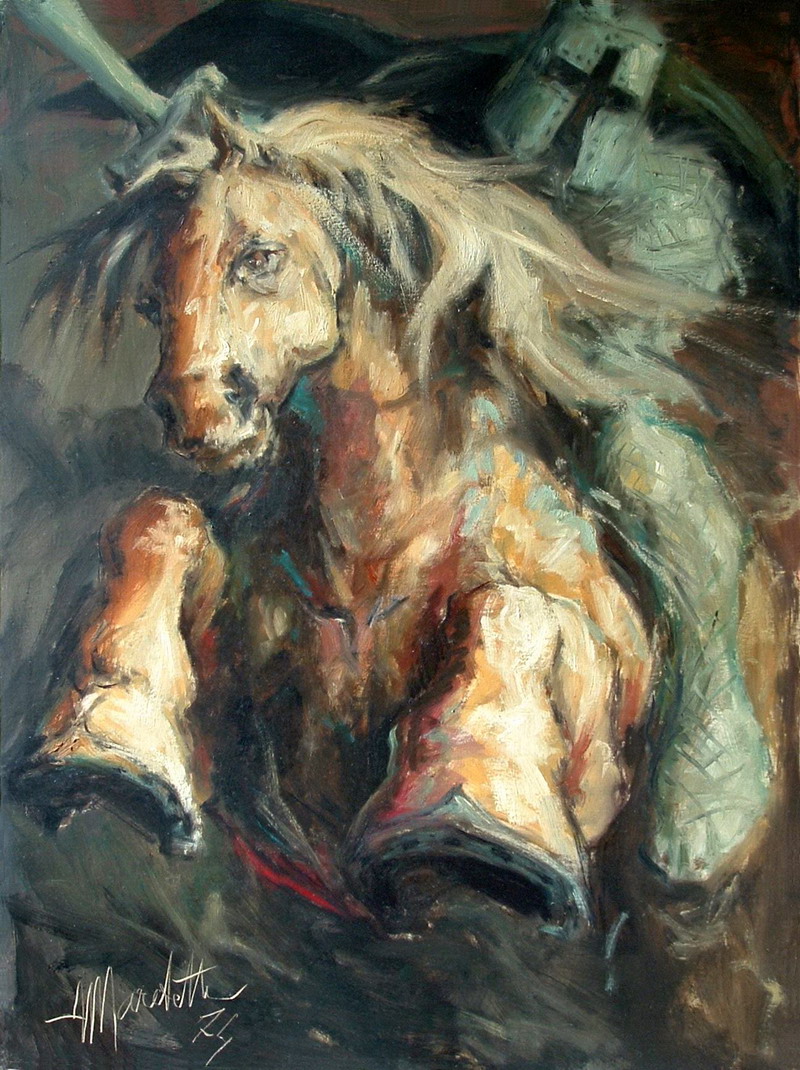
"Templar Knight," oil on canvas by Angelo Marchetti: the head and bust of a light-colored horse and, in the background, a knight in a tunic and cross-emblazoned helmet against a somber background.

"Templar Knight"
Oil on canvas, 1974, 80x60 cm (Cat.1082)

The 1930s - oil on canvas - Angelo Marchetti - K1231

"The 1930s"
Oil on canvas, 120x80 cm (Cat.1231)  

Oil on canvas by Angelo Marchetti

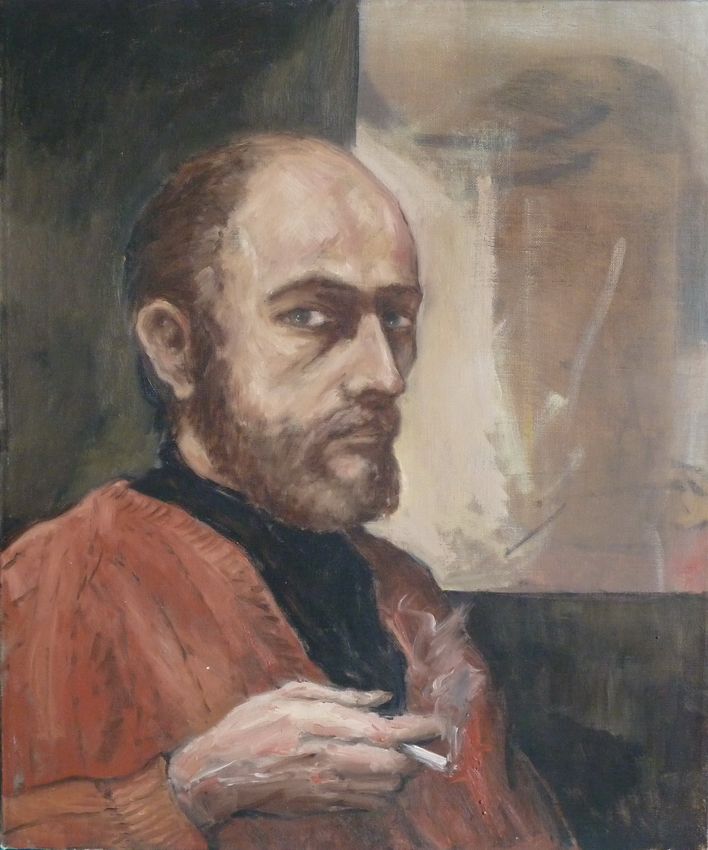
"Self-portrait"
Oil on canvas, 60x50 cm. (Cat. 1336) 

© 2026 Heirs of the artist Angelo Marchetti.
All rights reserved. Works and texts protected by copyright.

  • Publications
  • Exhibitions
  • Why collect
  • Contact
  • Press review


Latest work (K1235) added on 33 August 2026

  • Transparency & Integrity
  • Archive Criteria
  • Privacy & Cookie Policy
  • Association "Adaam"
  • Image Use & Rights
  • Sitemap