


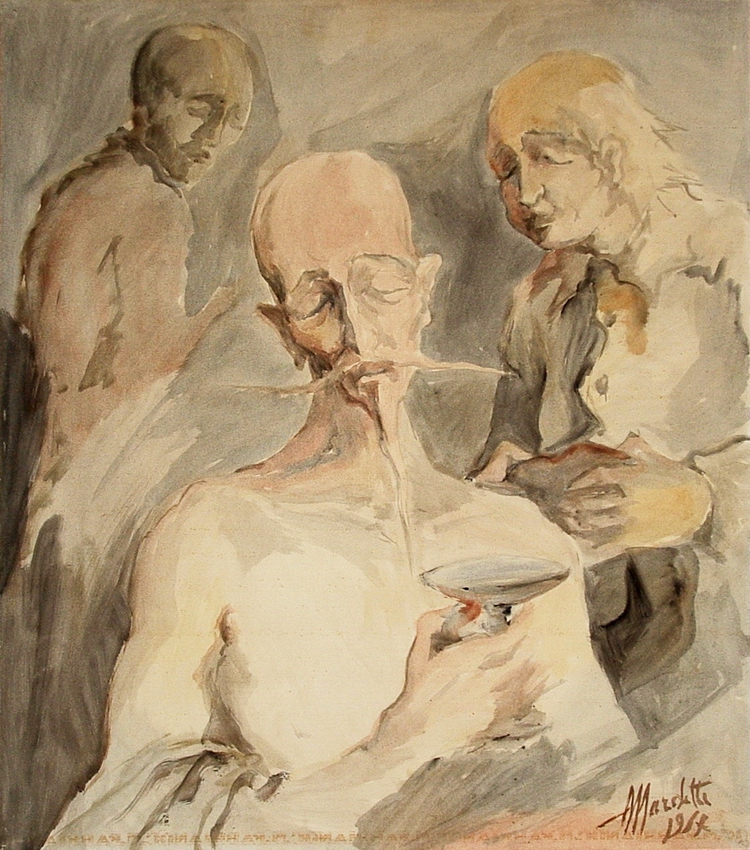
"Don Quixote"
Watercolour on Fabriano paper, 1967, 80×80 cm (Cat. 1235) Private collection GM
Text by the Association (ADAAM) - not independent criticism.
Visual descriptionThree half-length figures occupy a shallow space. There is no architecture: the ground is a field of unsettled greys and pale earth tones, without walls or horizon, and the planes are distinguished only by the overlapping of the bodies. At the centre, in the foreground and set lower than the others, is Don Quixote of La Mancha. He is rendered here as a gaunt, bald man, his head slightly inclined to one side, his eyes closed, his neck long and taut; the torso is bare, of a pale complexion, worked over with earthy glazes. Over his left arm he holds a pale cloth, perhaps a shirt; his hands hold, a little above the height of the belly, a cup on a short foot, pearl-grey in colour. The expression is submissive and pensive. Behind him to the left, a second standing figure, of a dark complexion, the head bowed and the eyes lowered towards the centre, the shoulder and arm barely indicated, is present there but anonymous, serving only as an ungainly onlooker. To the right, set higher, a further figure with more defined features, probably the innkeeper he met at the tavern on his first journey as a knight errant across the plain of Montiel, a figure described by Cervantes as a peaceable man yet a thief and a swindler. Here he is, behind Don Quixote, where he stirs for the first time: dishevelled in the few hairs at the temples, the broad forehead a pale ochre, with half the face in shadow, his gaze directed downwards towards the cup. His left hand, in the foreground, offers Don Quixote a piece of dark bread; the garment falls away in cold greys to a deep brown, the darkest accent in the whole of the right-hand side.
The signature, in reddish brown, is in the lower right-hand corner, followed by the date 1967. Along the lower edge runs a pale band bearing repeated, barely legible marks, though in all likelihood it is the papermaker's watermark, impressed in transparency across the full width of the sheet. It is from these observable elements that a reading of the relationships holding them together proceeds.
Critical analysisThe work belongs to the artist's figurative research on paper, a domain in which line and colour build space by subtraction; no perspectival system governs the scene: depth arises from the bodies drawing close to one another and from the gradations of tone. The space is compressed and frontal, and the three figures do not inhabit a place but occupy a surface. This shifts the whole weight of the narrative onto the postures, for around them there is nothing to situate the scene in any determinate time or place. The central figure, then, is Don Quixote of La Mancha, and his posture is the key to the whole; bare in the torso, gaunt and submissive in the face, weary in the body, he holds the cup with his right hand and bows his head with a composure that no other figure here possesses.
Here lies the observation that orders everything else: precisely in his nakedness as a man worn and stricken, the knight sets himself apart from the two figures that flank him. Not by position — he stands lower and more exposed than they do — but through a nobility of spirit that passes entirely through the way he holds his neck erect and tilts his head slightly, the relaxed shoulders, and the hand that holds the chalice; the gentleness of the gesture separates him from the context rather than binding him to it. The two lateral figures, indeed, work by contrast, for they are coarser in manner and in posture: the one on the left looms, barely defined, without sharp contours, a presence that weighs more than it acts; the one on the right struggles to emerge as it offers the hunk of bread with a more cursive, more concrete movement, devoid of that measure which, in its difference, governs the knight. Their bowed heads converge toward the centre, but it is a convergence of lowered gazes — so much so that one senses the eyes are closed, and surely opaque — while Don Quixote's recollection remains of another order.
The triangle traced by the three heads is not symmetrical, and this asymmetry is not merely compositional: it holds the noble figure distinct from the two that attend him without reaching him. Around this distance the represented instant is organised. Thus the observer is led to look also at the cup, held at the centre just above the height of the belly: it is not at the geometric centre of the composition, yet it is nonetheless its dynamic centre. The knight's pale torso, broad and lightly worked, is a zone of quiet upon which the other presences lean, and the reclined head introduces the only true movement.
If the bared body in the foreground stands between two clothed figures — between one who receives with dignity and one who offers with a coarser hand — and if the eyes, and consequently the gazes, ought to act as lines of force, guiding perception through the scene and establishing its dynamic, in this drawing they are not the scene's impulse: the artist has withheld that dynamism, particularly in the figure on the right, which, besides failing to assert itself where its gaze ought to be directed, seems instead to want to hold back the exchange. The dynamism therefore passes through the gestures and not through the gazes: the scene remains on a threshold of silence.
Colour is to be read as function, not as atmosphere. The earth tones — warm ochre, diluted sienna, reddish browns, among the artist's favoured hues — gather where there is skin and life: the brow on the right, the shoulders of the figure on the left, the signature itself. The greys, cool and restless, occupy the ground and the garments, lending weight and stilling the scene. The ivory-white of the torso is not a colour but a suspension: the paper is left almost untouched, a luminous void that isolates the knight and confirms his distance from the darker presences surrounding him. The deep brown on the right and the shadow at the lower left act as counterweights, preventing the whole from dissolving into light. The cup, pearl grey, is chromatically neutral: it draws the eye not by colour but by position, consistent with its role as pivot.
The key to the work is metaphysical, in the sense in which Marchetti's research is: the figurative scene does not exhaust itself in the rendering of the visible but becomes an inquiry into the human condition. Don Quixote's nobility is not recounted through an attribute or a heroic gesture, but emerges by subtraction, from the contrast with the coarseness of those beside him; and the light that rises from the torso and the cup does not describe a setting: it points to something more vast. What we see is an act, a giving and a receiving around a cup and a food, but the circumstances remain off-frame. This is not a genre scene: the setting and the objects of daily use are absent, and every indication of place and time has been deliberately excluded; nor is there a portrait, for the faces are withheld or lowered.
Thus the artist gives form to a distance: that between the idealist Don Quixote and the sensible world that nourishes him yet without understanding him , the sensible reality that surrounds him and in which he seems immersed without fully belonging to it. Nel creare la figura centrale, absorbed and suspended, holding the cup like an entity suspended between appearance and what appearance conceals, Marchetti wishes the observer not to ask to recognise the "how" of things, but to pass through it in order to interrogate the "why" that their form conceals.
English translation produced with the aid of artificial intelligence.