


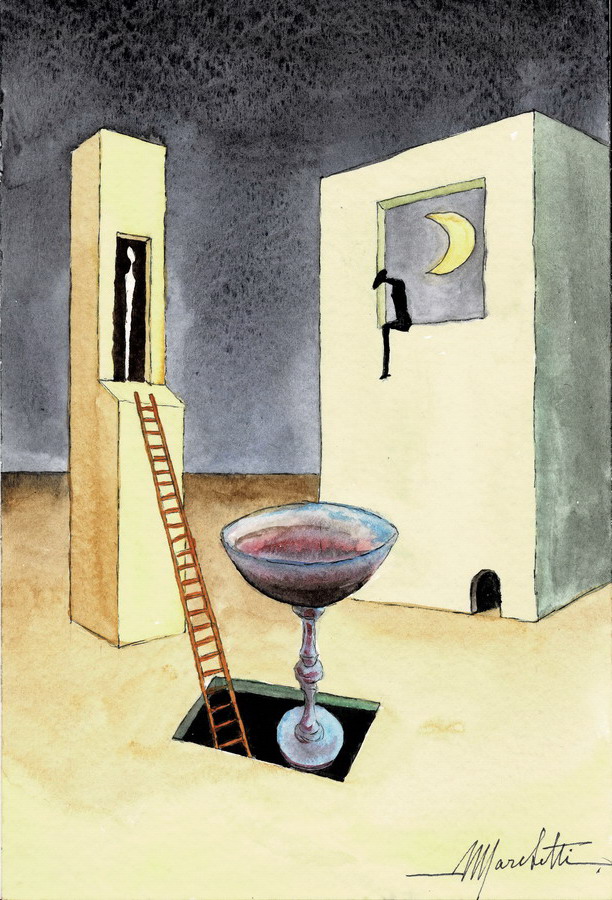
"Untitled"
Watercolour on paper, 30×20 cm (Cat. 468)
Text by the Association (ADAAM) - not independent criticism.
Critical analysisSpace here does not describe a place but a condition of the soul, suspended between the earth and the light that calls to it. The composition rests upon two tensions: one vertical, between fall and ascent; the other between the enclosed and the open. To the left, the stair that descends; to the right, the window that looks upwards; and at the centre the chalice, where the two tensions are drawn into a single knot. The chalice is the heart of the work. The red cup evokes at once the consecrated wine, blood shed for redemption, and the hermetic vessel of transmutation, in which base matter is brought to completion. That red is the alchemical rubedo and the colour of sacrifice. Yet the most telling detail is its position: the chalice hangs above a black opening, above the abyss. Salvation does not stand in safety; it offers itself on the edge of nothingness. The orange stair is Jacob's ladder, the bond between earth and heaven; here, however, the way begins with a descent, with the death of the old man that precedes every ascent. The two figures say the rest. The whitish form enclosed in the fissure on the left is the soul in its truth, the image of God buried in the body that conceals it; the rectangular block that contains it is that body, at once prison and casket of the light. The black silhouette at the window on the right turns its back on the moon, though a way, a faint brightness, lies open to it, and chooses to remain facing the dark interior of the room. The moon is nocturnal, reflected light, the first degree of brightness in the night of the world, a summons still subdued. That the figure should turn away from it alters the sense of the whole scene: this is not the soul on its way, but the soul that forgets, deaf to a call that is nonetheless close at hand. From this arises the tension that sustains the work; not a journey already begun, but its missing precondition, the conversion of the gaze. The true light is imprisoned and cannot free itself; the soul that might turn does not turn; the chalice waits above the abyss, and the stair, ready to be descended, shows that the way is available. Only the act is wanting. Every instrument of grace is present in the scene, yet all remain inert until the figure performs the simplest and most difficult gesture: to turn round. Marchetti fixes that suspended instant, the moment immediately preceding conversion, when everything is ready and consciousness has not yet consented.
English translation produced with the aid of artificial intelligence.